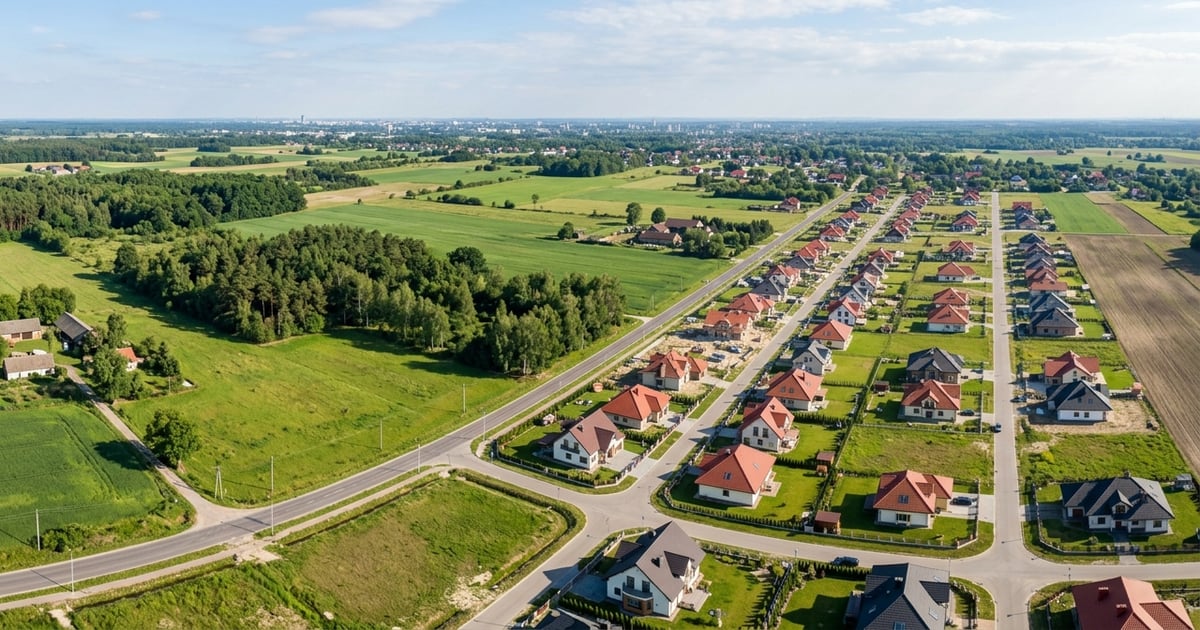
Generated with the help of AI
Notary Costs When Buying a Plot in 2026
---
Notary Costs When Buying a Plot in 2026
The Plot Buying Process – From Preliminary Agreement to the Deed
In short: The total notary costs when buying a plot primarily consist of the notary fee. To this, we add VAT, fees for deed excerpts, and court fees. Additionally, the notary collects the PCC tax. This amounts to exactly two percent of the land's market value. Therefore, in 2026, it's worth carefully planning this budget before visiting the notary's office.
Step 1. Verifying the Property's Legal Status in the Land and Mortgage Register
Before you buy land, check its legal status. Naturally, you first browse plots for sale in Poznań on the dimdom platform. Next, you must examine the land and mortgage register. Fortunately, you can check its contents for free in the Electronic Land and Mortgage Registers (EKW) system. Above all, examine the third section of the register. It often contains entries regarding right-of-way easements or third-party claims. Equally important is the fourth section. This is where mortgages are recorded. Unfortunately, debts usually transfer to the new owner. As a result, verifying this data is essential. This way, you will avoid financial problems.
Step 2. Signing the Preliminary Agreement
Once you have checked the legal status, secure the transaction. The preliminary agreement serves this purpose. This document outlines the conditions of the future sales contract. Importantly, you can conclude the preliminary agreement in writing or at a notary's office. However, the notarial form is much safer. If the seller suddenly backs out of the transaction, a notarial deed provides you with protection. You can then demand the transfer of ownership in court. Of course, this requires paying a notary fee. On the other hand, it guarantees that the plot will ultimately end up in your hands.
Step 3. Paying a Deposit or Advance
A preliminary agreement usually requires a financial payment. In Polish law, we have two main concepts: a deposit (zadatek) and an advance payment (zaliczka). Crucially, their legal consequences differ significantly. First and foremost, a deposit serves a protective function. If you back out as the buyer, the seller keeps the paid amount. However, if the seller changes their mind, they must return double the deposit to you. An advance payment, on the other hand, is merely a fraction of the price. Therefore, if the purchase falls through, the advance is returned to you in full. In this case, it doesn't matter whose fault it was.
Step 4. Finalizing the Transaction at the Notary's Office
The most important moment is the visit to the notary's office. This is where you sign the final agreement. According to the law, transferring ownership requires a notarial deed. Otherwise, the contract will simply be invalid. During the meeting, the notary reads the entire document aloud. This is your last chance to ask questions. Then, both parties sign. At the same time, the buyer pays the notary costs. Namely, the notary collects their fee, court fees, and the PCC tax. They then forward this tax to the tax office. Furthermore, professional real estate agencies often help coordinate the meeting.
Step 5. Filing Land and Mortgage Register Applications by the Notary
The final stage is updating the data in court. Currently, in 2026, the document flow is very fast. The notary submits the application via an online system. Thanks to this, they immediately register you as the new owner. Additionally, they inform the court to remove old debts. They can also register a new mortgage for the bank. As a result, the buyer only needs to pay these costs during the visit to the notary.
What Documents to Prepare for the Notarial Deed?
Gathering documents is the seller's responsibility. However, as a buyer, you should know what the notary requires. Unfortunately, missing a single document can block the transaction for a long time. Moreover, offices have their own deadlines for issuing documents. Therefore, it's worth starting to collect the paperwork much earlier.
Required Documents
An excerpt from the land register and an excerpt from the cadastral map with an annotation that it is intended for the land and mortgage register.
The land and mortgage register number maintained for the given plot.
A certificate on the plot's designation in the Local Spatial Development Plan (MPZP).
A decision on building conditions if no MPZP has been adopted for the area.
The basis of property acquisition by the current owner (e.g., a notarial deed of donation).
A certificate confirming no registered residents if there is an old building on the plot.
A revitalization certificate confirming whether the plot is located in a Special Revitalization Zone.
A certificate of no tax arrears owed to the municipality.
Spousal consent to the sale if the property is part of joint marital property.
A bank certificate regarding the outstanding debt balance if the plot is burdened with a mortgage.
- - - - - - - - - -
Notary Fee – How Much Will You Pay the Notary?
The notary's remuneration is not arbitrary. Maximum rates are determined by a special regulation. You can check its contents in the Internet System of Legal Acts (ISAP). According to this law, the fee increases with the value of the plot. Thus, the market value is the main basis for calculations. Importantly, you cannot intentionally understate the price in the contract. After all, the notary and the tax office know the real market prices in the area.
For example, when buying a plot worth over sixty thousand PLN, the notary fee is one thousand and ten PLN. To this, a fraction of a percent of the surplus is added. Next, we add VAT to this amount. It stands at twenty-three percent. Since market competition is high in 2026, it's worth negotiating the rate with the notary.
Furthermore, fees for deed excerpts are an additional cost. The original contract always remains in the notary office's archive. In turn, the parties receive excerpts with full legal force. Each such excerpt costs a maximum of six PLN net per page. Additionally, the notary sends them to the court, the tax office, and the municipality. As a result, the total cost of the copies usually ranges from one hundred to three hundred PLN.
Taxes and Court Fees When Buying a Plot
The largest cost for the buyer is the PCC tax. According to data from the podatki.gov.pl portal, it amounts to exactly two percent. Naturally, the basis is the market value of the land. If the tax office decides that the price in the contract is too low, it will demand an additional payment. You will then also pay interest. That's why you can read more about this in our guide on how to calculate PCC tax.
It's worth remembering that the PCC exemption for a first apartment does not apply to plots. Therefore, when buying land, you always pay this tax. Here, the notary acts as the payer. Namely, they collect the amount during the deed signing and deposit it into the tax office's account.
Another group of expenses is court fees. First and foremost, the fee for registering ownership is two hundred PLN. If you are buying a new plot without a register, you must set one up. The cost is then one hundred PLN. In turn, if you are taking out a loan, there is also a fee for registering a mortgage.
Costs and Deadlines
Type of fee
Amount / Rate
Payment deadline
PCC tax
2% of market value
On the day of signing the deed
Ownership right registration
200 PLN (fixed fee)
On the day of signing the deed
Establishing a land and mortgage register
100 PLN (fixed fee)
On the day of signing the deed
Risks When Buying a Plot and How to Avoid Them
Buying land requires great vigilance. Unfortunately, debts can ruin your building plans. As a result, you expose yourself to losses. The dimdom platform connects transaction parties. However, the buyer must verify the legal status. For this reason, many people first browse houses for sale. This makes it easy to compare investment costs. Above all, always analyze the documents and ask the notary.
Most Common Mistakes
Failure to verify physical and legal access to a public road.
Ignoring the right of first refusal held by the municipality or the State Forests.
Not checking the MPZP provisions and buying an agricultural plot with no building possibilities.
Skipping a thorough analysis of the fourth section of the land and mortgage register for mortgages.
Downplaying third-party claims listed in section III of the land and mortgage register.
- - - - -
Finally, pay attention to the right of first refusal. It often requires signing a conditional agreement. The notary then sends a letter to the office. Only after the municipality waives its right do you sign the final deed. As a result, this procedure requires a second visit to the notary's office. This also means a double fee for excerpts. ---
Sources
- Taksa notarialna - Ministerstwo Sprawiedliwościwww.gov.pl
- Podatek od czynności cywilnoprawnych - Portal Podatkowywww.podatki.gov.pl
- Założenie księgi wieczystej - gov.plwww.gov.pl
- Rozporządzenie Ministra Sprawiedliwości w sprawie maksymalnych stawek taksy notarialnejisap.sejm.gov.pl
- Planowanie i zagospodarowanie przestrzenne - gov.plwww.gov.pl